
Core Difference
AB Material = Polymer Alloy
- Composition: Chemically fused blend of Polycarbonate (PC) + ABS resin
- Key Advantage: Combines PC’s heat resistance & ABS’s impact strength
Pure ABS = Basic Engineering Plastic
- Single Material: Acrylonitrile-Butadiene-Styrene terpolymer
- Limitation: Low cost but inferior heat/flame resistance
Critical Performance Comparison
| Property | AB Material (PC/ABS) | Pure ABS |
| Heat Resistance | No deformation at 130°C | Softens above 90°C |
| Flame Retardancy | UL94 V-0 (Self-extinguishes in 3s) | UL94 V-2 (Burns up to 30s) |
| Impact Strength | 35 kJ/m² (Automotive-grade) | 20 kJ/m² (Consumer-grade) |
| Long-term Stability | 10-year anti-aging performance | Yellows/brittle after 3 years |
Application Scenarios
Choose AB Material for:
- High-heat devices (>1000W power/industrial equipment)
- Safety-critical settings (hospitals/data centers/children’s rooms)
- Outdoor use (requires UV resistance)
Pure ABS only suitable for:
- Low-power devices (phone chargers/desk lamps)
- Short-term use products (promotional gifts/temporary wiring)
- Cost-sensitive projects (safety compromised)
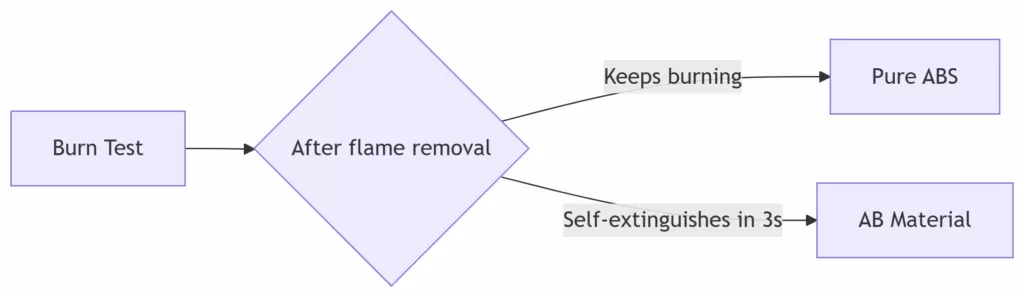
Flame Test Tip:
Apply flame to edge (Caution: Test samples only!):
- Pure ABS: Keeps burning/dripping
- AB Material: Self-extinguishes immediately